Nine tools, one bill

Everything a nine-tool stack does, minus the nine bills

skynat.ai replaces the spreadsheet, the WhatsApp thread, the invoicing app, the CRM, the payroll service, the stock sheet and the notebook of expense slips — with one system that actually talks to itself.
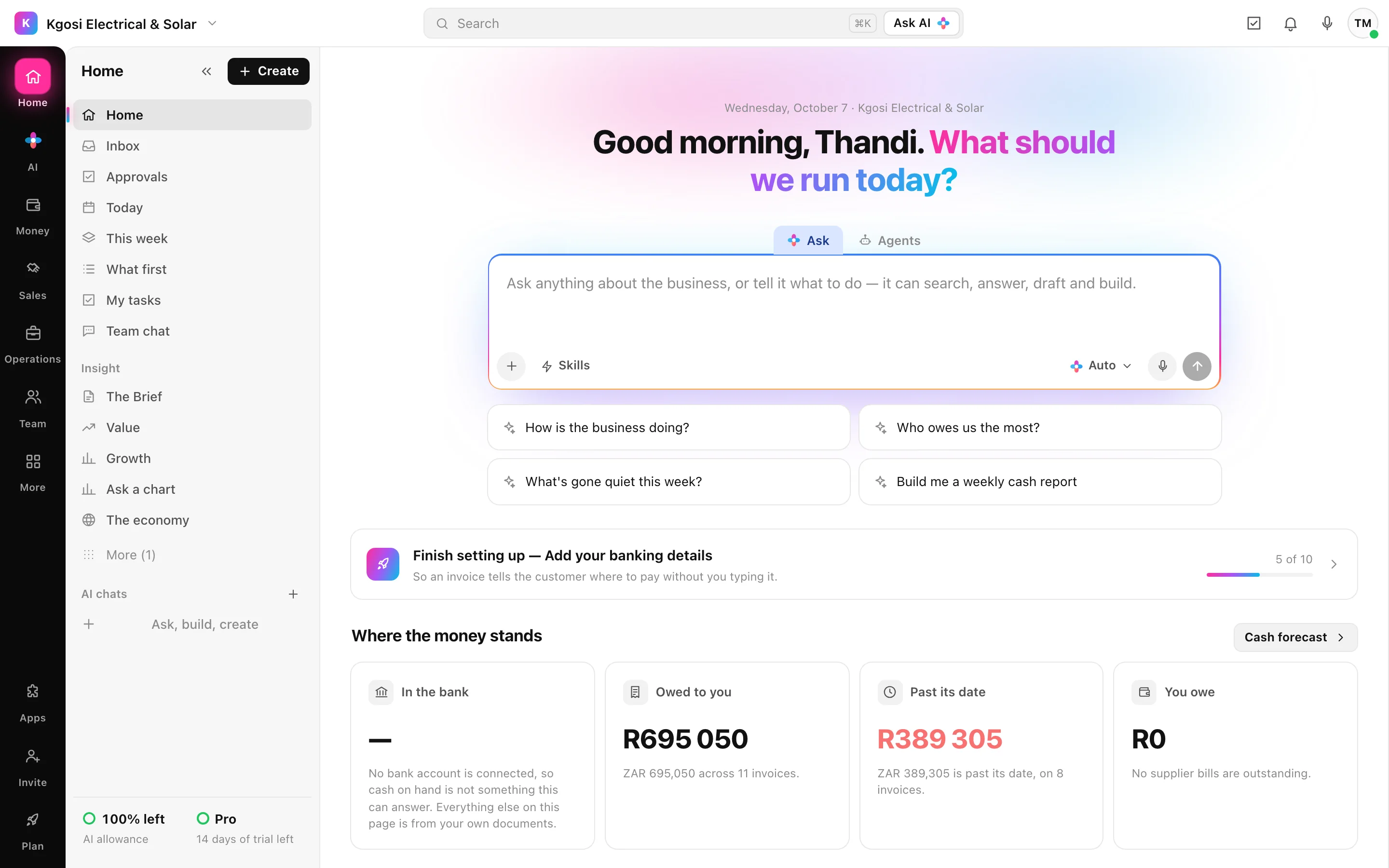
The Skynat AI home screen: ask anything, and where the money stands
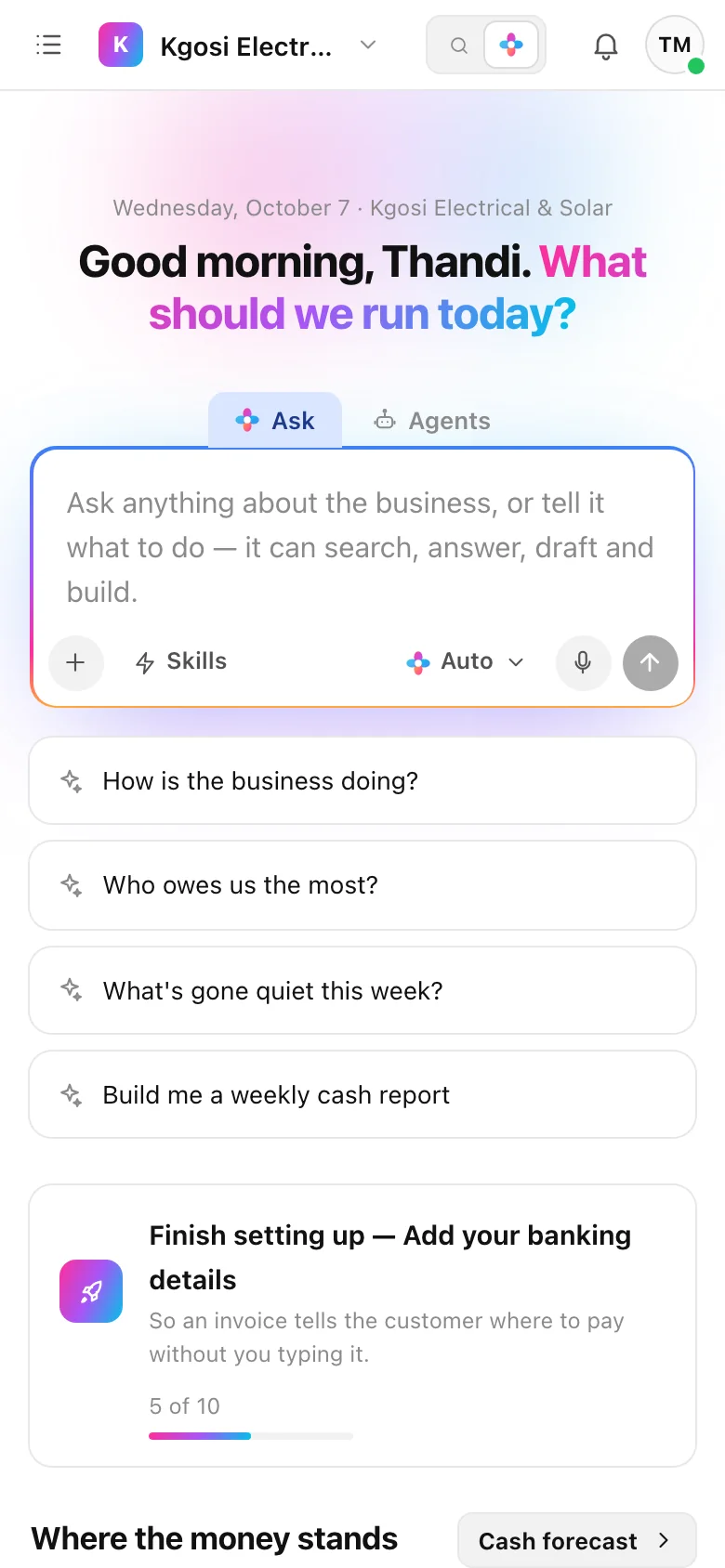
The same, on a phone

One home screen for the whole business — on the laptop and on the phone.

Nothing has to be reconciled

One data model. A price changes once, a customer's name changes once.

Nothing has to be reconciled

Customers, quotes, invoices, stock, staff, jobs, deliveries and expenses are rows in one schema rather than records in eight products with a sync job between them. There is no sync, because there is nothing to sync.

The cost of the alternative is not the subscriptions. It is that a price typed into four places is right in three of them and nobody can say which three. Margin per job, per customer and per line only exists at all when the catalogue, the invoice and the ledger are the same thing.

It cannot do the thing you would not forgive

Three autonomy settings, and none of them moves money without a person.

It cannot do the thing you would not forgive

The boundary is enforced in code, from each tool's own classification, rather than from what the model says it is about to do. An assistant that reports its own intent is an assistant that can be wrong about it.

A per-action limit on its own bounds nothing — a hundred payments just under it pass one at a time — which is the entire reason the daily figure exists.

Two numbers sit on top of that: the most it may move in one action, and the most in a day. Both are empty when you start, and empty means zero.

The books are right when the deadline arrives

A real double-entry ledger underneath, not documents in a folder.

The books are right when the deadline arrives

Every invoice, payment, expense and stock movement posts on the date it happened. The tax return is a report over records that were already correct, rather than a fortnight spent rebuilding a year from bank statements.

This is the difference between a ledger and a folder of PDFs with a spreadsheet beside it. A document store can tell you what you sent. Only a ledger can tell you what you are owed, what you owe, and what the month actually made.

Your records come with you

Closing the account offers you a copy first. Tax authorities want five years of invoices.

Your records come with you

Type the business name, wait a week, and you are offered a complete copy of every table the workspace owns before anything is removed. A test fails when a new table is added without one, so the copy cannot quietly fall behind the schema.

There is deliberately no one-click export wizard, and this page says so rather than implying otherwise. The retention obligation outlives us either way, so deleting your records on request would not be a kindness.

It already knows what your trade watches

A logistics operation watches empty running. A funeral parlour reads the tag at every hand-over.

It already knows what your trade watches

A pack changes which findings rank first and what each officer says it is watching, in the vocabulary that trade actually uses. And the trades whose work is a register have theirs — a clinic's sealed records, a funeral parlour's cases, a herd register, a pawn book, a guest register — on the same ledger as the money.

The alternative is the configuration project every general-purpose system starts with, where six weeks go on deciding what the fields should be called before anybody has invoiced anything.

Proof exists before there is an argument

Geotagged, timestamped and attributed, captured as the work happens.

Proof exists before there is an argument

Signed quotes, delivery proof, site photos and certificates, each tied to the job and to the person. The point is the timing: evidence gathered after a dispute starts is evidence somebody assembled, and everyone in the room knows it.

What it changes commercially is the discount nobody admits to. A business without proof writes off part of an invoice to keep the relationship and books it as a discount, rather than as the cost of not having a photograph.

It works where the signal does not

A retry never does the thing twice, which is the whole failure mode of offline.

It works where the signal does not

Every field action is written to a queue with a key the phone generated, so the same delivery confirmed twice on a bad connection is one delivery. Without that key, working offline means occasionally charging somebody twice and hearing about it from them.

The rep who loses the network between the third shop and the eleventh keeps working. What syncs when the signal returns is the queue, in order, with the keys — not a best-effort replay.

Built for how trade actually works

The phone number as identity. The credit book as a real ledger.

Built for how trade actually works

Landmark directions instead of a street address nobody uses. Cash in a rider's bag treated like a till, with a float and a reconciliation. Scheduled power cuts modelled, because where they happen they shape the working day rather than interrupting it.

These are not localisations bolted onto a product designed for one market. A system that assumes a verified street address and an always-on card terminal does not fail loudly where neither is a given. It fails by being worked around, until the spreadsheet comes back.

Your customers can tell your invoice from a copy

Every quote and invoice carries a code to check it by.

Your customers can tell your invoice from a copy

The commonest fraud against a small business's customers is a copy of its invoice with the bank account changed. Each document carries a code and a short address: anybody holding it opens the document as it was issued, with your official details, and a customer who is unsure asks you to confirm it before paying.

When a customer compares the account they were given and it is not yours, you are told at once — while the scam can still be stopped, rather than when somebody says they paid.

The scams aimed at you are said before they cost you

The fake proof of payment, the overpayment refund, the fake purchase order.

The scams aimed at you are said before they cost you

A proof of payment is set against the bank lines you bring in and read for the signs of editing. A refund of an overpayment, from money not yet seen cleared, is held. A buyer calling itself a public body from a free mail address is flagged on the quote.

None of it refuses anything. Each is said, with the facts behind it, at the moment the decision is made — the only moment a warning is worth anything.

Work done is work paid for

The finished job nobody invoiced is found, not forgotten.

Work done is work paid for

Finished jobs with no invoice, notes that read like work beyond the quote, and stages of long jobs reached and not claimed are listed, each one tap from an invoice.

And every quote is read before it goes — the margin against your own floor, the customer's record of paying, the stock on the job date — because the expensive mistakes are made at the quote and found months later.

One price, not nine

Nine subscriptions and seven integrations, and the data still never joins.

One price, not nine

Assembling the competition costs more than the bill. It costs the person whose job becomes carrying figures across the gaps, usually on a Sunday, and that person is on nobody's quote.

It is also why nobody can benchmark a business like yours, cost a job properly, or tell you what your peers pay. Those answers need the numbers in one place, and in a nine-tool stack they never are.

20

trades with a page of their own: the problems each one has, and what it does about every one

1

shared data model — zero sync issues between the tools you use every day

0

money movements or customer messages the AI sends without a person seeing them first

The comparison

Nine subscriptions that never agree

Bought separately

  • A price change typed into four places
  • A customer whose name is spelled three ways
  • Nobody can tell you your real margin
  • The tax return rebuilt from bank statements
  • Nine bills that never stop

skynat.ai

  • One ledger underneath all of it
  • One customer record, everything hangs off it
  • Margin per job, per customer, per line
  • The return is a report, not a reconstruction
  • One subscription, from $29

The full comparison, kind of tool by kind of tool →

Pricing

14 days free, then one bill

No card to start. Per seat, because a team of ten should not run the agent on one person's subscription.

Solo

$29

a month, including 3 seats

One person, or one person and a hand or two.

  • Quotes, invoices, and the customer portal
  • The full ledger — VAT, bank feeds, cash forecast
  • The AI assistant, with a monthly allowance
  • 3 seats included, then $14 each
Start free trial
Most chosen

Pro

$19

per seat, per month

A team that runs the business in here every day.

  • Everything in Solo
  • No base charge — pay for exactly the seats you use
  • Named agents on a schedule, and the overnight sweeps
  • Field seats at $7 for drivers and technicians
Start free trial

Business

$34

per seat, per month

Several locations, or a team that leans on the agent hard.

  • Everything in Pro
  • Branches, consolidated reporting, multi-currency
  • More than three times the agent allowance per seat
  • Priority support
Start free trial

Enterprise

Custom

volume seats from $28 each

Volume seats, your own security review, a contract.

  • Everything in Business
  • Volume seat pricing from $28
  • Single sign-on and directory sync
  • Annual terms, purchase orders, invoicing
Talk to us

Full detail, including field seats and what the agent costs, on the pricing page.

See it against your own numbers

Your workspace is ready in minutes. Nothing to install.