Find out you are in the bottom quarter while you can still move
Most businesses know their revenue and almost nothing else. They do not know their real margin, how long they actually take to get paid, how many quotes turn into work, or whether any of those numbers are normal for their trade — because there has never been anywhere to look.
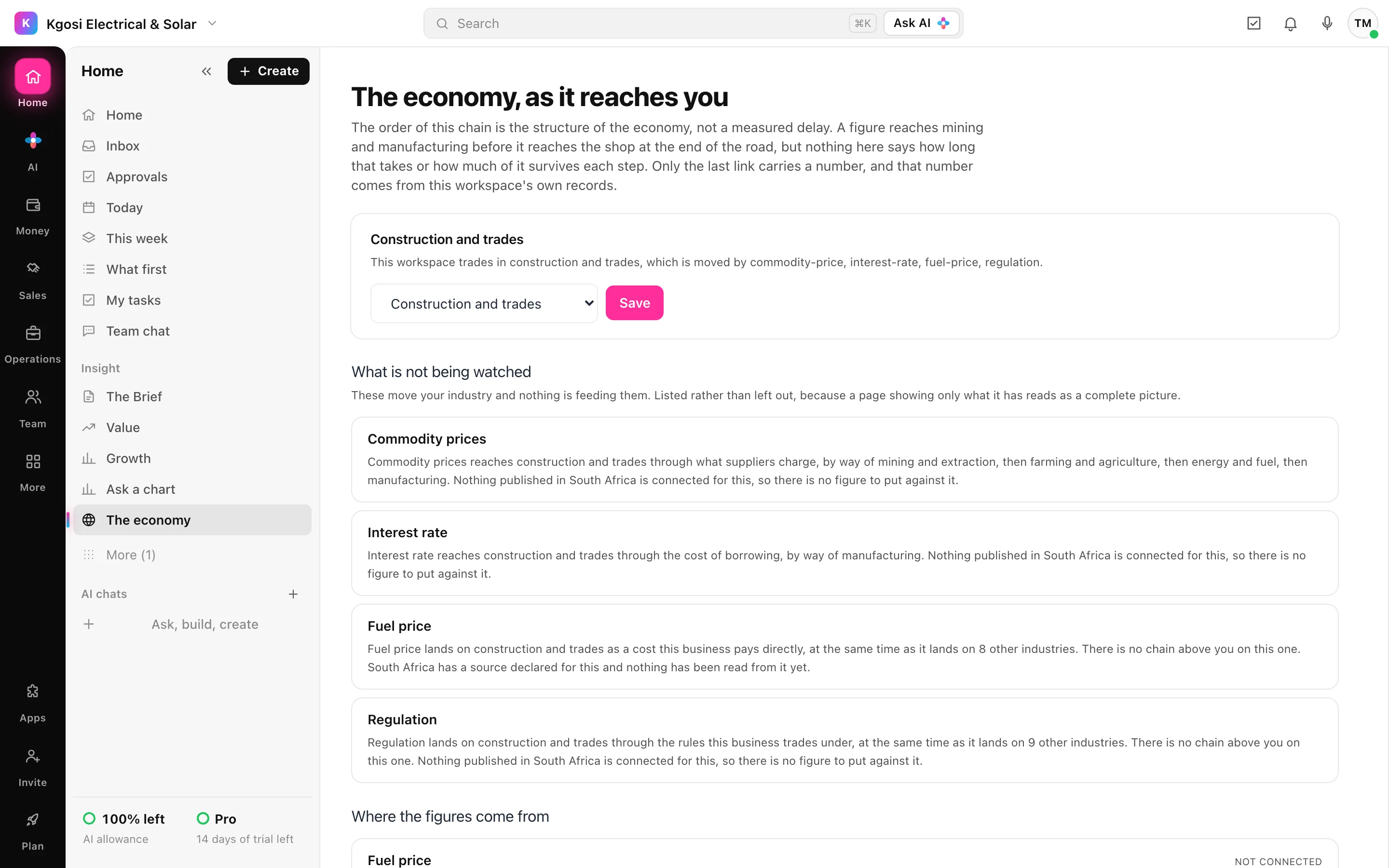
What moves your trade, watched for you.

An average is dragged about by one outlier and tells a business almost nothing. Where you sit in the distribution is a sentence somebody can act on.
5
businesses minimum before any comparison is reported — a cohort of two is one competitor reading the other
0
figures shared until a workspace opts in, and turning it off stops both immediately
0
businesses ever named in a comparison
15 things, and what each is for
Where something needs an account of your own before it will work, it says so.
You find out your margin is below the middle of your own trade
Gross margin, how long invoices take to be paid, how many quotes turn into work, and average invoice — against businesses in the same trade.
Nothing below five
Nobody can read your numbers out of a comparison
Nothing is reported below five contributing businesses, and the floor is stated rather than silently applied — a comparison that quietly disappears looks like a bug.
Margins per customer and per job
The customer you like most is sometimes the one costing you
True margin per customer, per job, per lane and per product, after the costs that actually attach to each.
KPIs and dashboards
The four numbers that matter, without building a report
Headline figures on one screen, per business, with the metrics a trade actually watches rather than a generic set.
What-if
You can test a decision before you make it
Change a price, a cost or a volume and see what it does to the figures you already have.
Predictions
You see the shape of next month
From the invoices, bills, commitments and patterns that already exist — not from an optimistic assumption.
The software already knows what your trade watches
A logistics operation watches empty running; a retailer watches stock turn.
Goals
A target somebody set in January is still visible in June
Goals with numbers and dates, measured from the work rather than from a status meeting.
Nobody drives to a job the power will be off for
Where the grid is scheduled, the schedule is part of the working day and almost no business software models it.
A month of power in money: bought, sold, saved by the sun, and what would cut it
Each day at your own tariff: what was bought and when, what the solar saved, what the generator cost a kWh.
Your solar, battery and meter, read where they already report
A solar system, a battery, a meter or a switch is read from the maker's own cloud, or by a small bridge beside SolarAssistant or Home Assistant.
You know how long people wait for an answer from you
Enquiries from every direction count: the web form, a WhatsApp message, a call somebody logged, a request typed in by staff.
Advice drawn from your own won and lost quotes, not from somebody else's business
Each observation compares this workspace's own won and lost quotes on something that was recorded: whether it was followed up.
You see the money more trade needs before its profit arrives
More sales means stock bought before it is sold, wages paid before the invoice is, and money waiting with customers for as long as yours actually take to pay.
You see the route from a figure in the news to a line in your own books
From a figure at the top — the interest rate, the fuel price, the exchange rate — through the industries it passes.
None of this is a separate subscription
Same ledger, same customer record, same team — read from a different angle.









See it against your own numbers
Your workspace is ready in minutes. Nothing to install.