What it was built for
Not a wall of logos. The situations the engine was actually designed around, trade by trade — what goes wrong today, and what the product does about it.
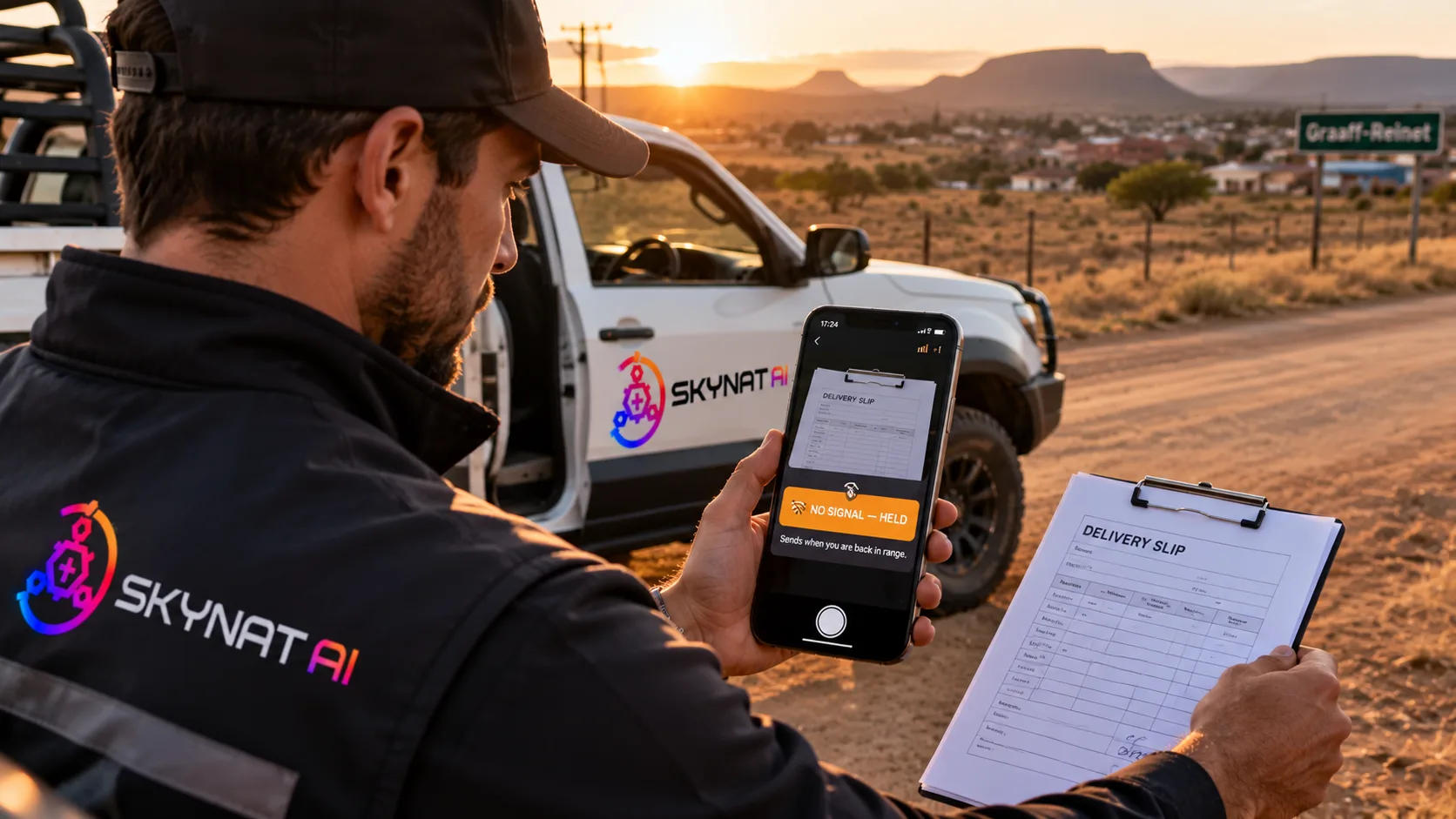
Built for work that happens where the signal does not.

Solar installers and contractors
The customer says it was not done, or not done on the day they were billed for. You know it was. Neither of you can show anything, so the invoice gets discounted to keep the relationship.
Proof is assembled as the work happens — before, after, where, when, who, and a signature — rather than asked for after somebody disputes it.

Wholesalers and distributors
A brand sells a container and that is the last thing it knows. Which shops took what, and which stopped, is invisible until the next order does not arrive.
Penetration per line, must-stock gaps defined by what comparable shops actually carry, and listings that have quietly gone to a competitor.

Multi-branch retail
A weekend-long stocktake once a year, and dead stock discovered when it is already a write-off rather than while it can still be cleared.
Demand velocity from the sales that already happened, batch expiry surfaced before the date, and a weekly count on one bin instead of an annual count on everything.

Clinics and practices
No-shows cost the slot, and a denied claim quietly ages into a write-off — nearly half of denials are never reworked anywhere.
Reminders in the channel people actually read, and claims tracked with an aging clock until they are genuinely resolved.

Couriers and logistics
Twenty to forty percent of cash-on-delivery parcels are refused at the door, and it reads as fuel rather than as a loss. Rider cash is reconciled by counting a bag and hoping.
Every attempt counted including the failures, and the rider's bag treated as a till — float out, collections in, counted back, variance surfaced.

Security and cleaning firms
Attendance across thousands of sites is verified by telephoning the gate. Ghost workers are the largest single cost leak in the industry and nobody can prove one.
A coordinate taken at the gate, computed on the server rather than trusted from the phone, with every unconfirmed sign-on listed for a supervisor with the reason it could not be placed.
No customer stories here yet, and we are not going to invent any
skynat.ai is new. When there are businesses running on it with numbers worth reporting, this page becomes case studies with their names on them and their figures in them. Until then it says what it is built for, which is the part that is true.
14 days free, then one bill
No card to start. Per seat, because a team of ten should not run the agent on one person's subscription.
Solo
$29
a month, including 3 seats
One person, or one person and a hand or two.
- Quotes, invoices, and the customer portal
- The full ledger — VAT, bank feeds, cash forecast
- The AI assistant, with a monthly allowance
- 3 seats included, then $14 each
Pro
$19
per seat, per month
A team that runs the business in here every day.
- Everything in Solo
- No base charge — pay for exactly the seats you use
- Named agents on a schedule, and the overnight sweeps
- Field seats at $7 for drivers and technicians
Business
$34
per seat, per month
Several locations, or a team that leans on the agent hard.
- Everything in Pro
- Branches, consolidated reporting, multi-currency
- More than three times the agent allowance per seat
- Priority support
Enterprise
Custom
volume seats from $28 each
Volume seats, your own security review, a contract.
- Everything in Business
- Volume seat pricing from $28
- Single sign-on and directory sync
- Annual terms, purchase orders, invoicing
Full detail, including field seats and what the agent costs, on the pricing page.






See it against your own numbers
Your workspace is ready in minutes. Nothing to install.