Built for how trade actually works here
Most retail and distribution software is designed for a shop with a street address, a card machine and a customer who has an email. A great deal of trade on this continent has none of those. It has a phone number, a notebook, a rep on a route, and a shopkeeper who sells on credit all day.
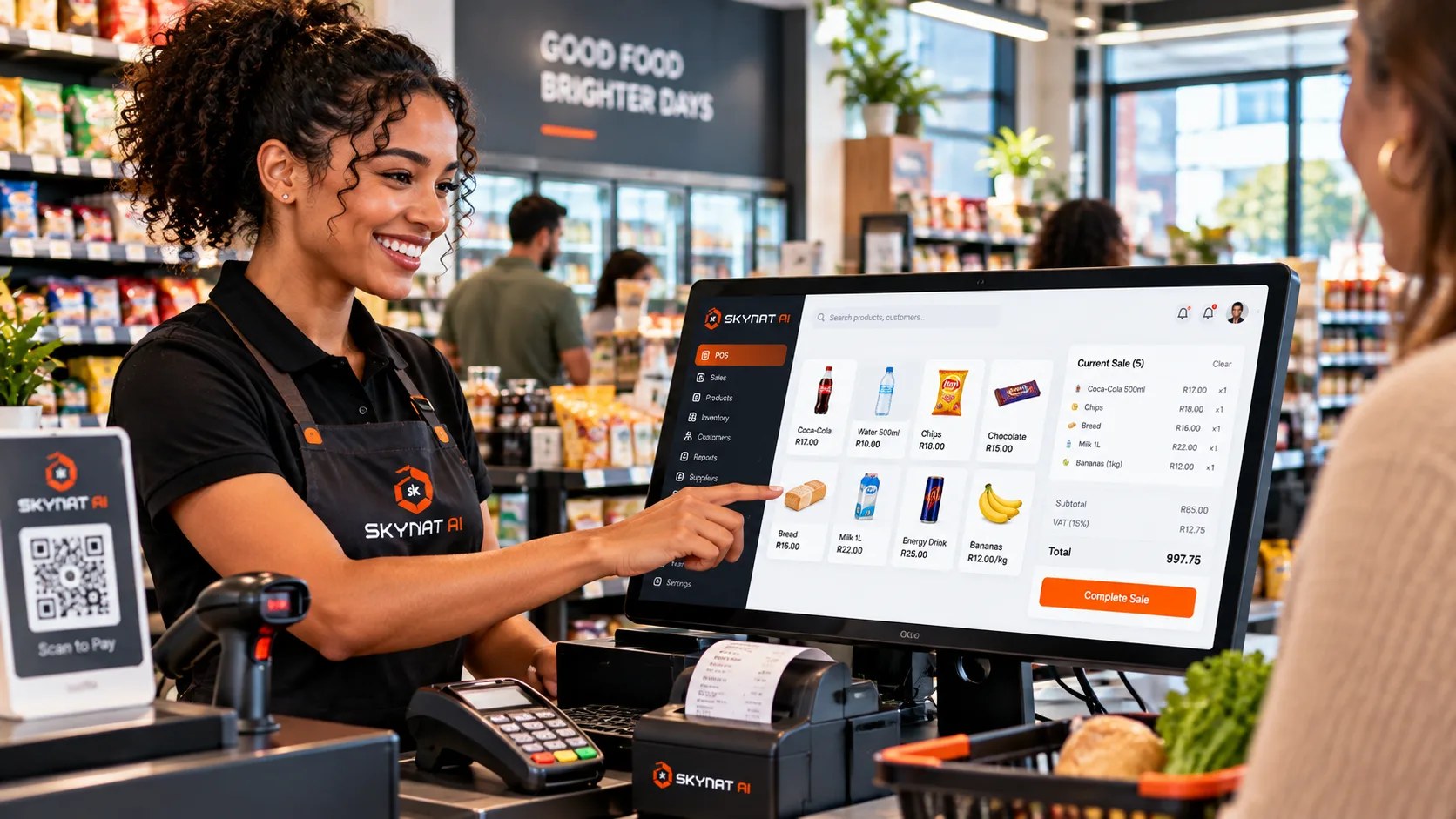
The till, the floor and the books as one.

None of this is a lesser version of the real product. It is the real product, designed for the counter rather than the desk.
1
phone number as identity — no card, no app, no email
0
second set of books — a credit entry is a real invoice
150m
how close a rep has to be for a shop visit to count as verified
25 things, and what each is for
Where something needs an account of your own before it will work, it says so.
Cross-border paperwork done before the truck leaves
For a sale to another country: the customs code for each product, whether your goods qualify for the free-trade tariff.
Record a sale from any phone, with no data
Text a sale, a payment or a stock count to your business's number and get a reply to confirm.
People's AI assistants can order from you
Switch on your shop front and the AI assistants people use can see what you sell and ask for an order.
The notebook stops being the largest asset nobody protects
Two fields and an amount, at the counter, and the customer does not have to exist yet.
Credit limits that learn
Credit for the customers who have earned it, in a number
Each customer's own record suggests how much credit they have earned: more for those who pay on time, less for those who do not, with the reason in one line. Only the owner sets a limit.
Every "SOLD 12" in the comments becomes an order
Give each product a short code for the stream.
Small shops together pay the pallet price
Shops near each other buy together and reach the wholesaler's bigger-order prices.
You know what your street buys, like the supermarket does
Shops in your area that choose to take part see what their street buys: what is moving, what is rising, and what sells nearby that you do not stock.
Point the phone at anything with a code and it knows what it is
Every code in view is outlined where it is, with what it is: a product with its price and stock, a bin and what is in it, a pay or check code.
'Thandi paid fifty' lands somewhere sensible without anybody deciding
A repayment goes against the oldest debt first, which is the rule every shopkeeper already uses and the one a customer can be told in a sentence.
You see the debt that is turning into a loss, not the biggest one
Ordered by how long it has been sitting, not by size.
A loyalty scheme that actually enrols people
Identity is the phone number — not a card nobody carries, not an app nobody installs.
What the points will cost you
You know what you will owe when everybody comes back at once
Every rewards product reports members. This reports the liability too: points outstanding, and what they are worth if every one of them is redeemed tomorrow.
Who stopped coming
The most valuable list a retailer has and the one nobody keeps
Customers who used to buy weekly and have not been in for two months have not churned quietly — they have gone somewhere else, and you already have their number.
Your reps stop deciding for themselves which shops matter
Every outlet with its channel, its grade, how often it should be called on, and the landmark directions somebody actually needs to find it.
A route that gets rained off does not mean a shop waits another week
Shops due today are the ones on a route scheduled for today plus any past their own visit cadence, overdue first and best shops first within that.
A visit report typed up at home stops counting the same as a visit
The phone's coordinates are checked against the shop's pin when the rep arrives, and the distance is computed here rather than trusted from the phone.
Strike rate
Reps stop being measured on something they can manufacture
Visits that ended in an order, not visits. A rep measured on visits will produce visits.
The number a brand asks for first and no distributor can produce
For each line, how many of the outlets that bought anything take it.
The twelve shops a rep should argue with tomorrow morning
Outlets not carrying a line that most comparable shops in the same channel do carry.
You notice a competitor taking your shelf
An outlet that took something every fortnight for a year and has stopped has not changed its mind.
The till and the books stop being two systems
Products as tiles with their pictures, a basket that fills as you scan, cash with the change worked out, the card machine or Skynat Pay.
The scanner you already own works on the first beep
Nearly every USB or Bluetooth scanner types like a keyboard, and that works with nothing to install.
Receiving at the door
A delivery is booked in by scanning it, not by typing
The same till turns round to take stock in: scan what arrived, book it onto the shelf, and every change to stock keeps its reason — sold, received or counted.
Moving from another till does not mean typing your catalogue again
Import the export from Square, Shopify, Loyverse, WooCommerce, Lightspeed or Clover, barcodes and stock included.
None of this is a separate subscription
Same ledger, same customer record, same team — read from a different angle.






See it against your own numbers
Your workspace is ready in minutes. Nothing to install.